

A LaSalle Street office tower is on track to become 349 apartments. The City just changed the deal again.
The Council swapped the nonprofit partner and adjusted the affordable units in the plan for 30 N. LaSalle, the Loop landmark that replaced the old Stock Exchange.
For most of its life, 30 N. LaSalle St. has been an office building in the middle of the Loop's financial district. After five City Council votes this year, the plan is for most of its lower 18 floors to become 349 apartments, nearly a third of them affordable.
On Sept. 23, the City Council passed two more pieces of that plan by votes of 50 to 0. One swaps the nonprofit partner that receives the City's money and revises the redevelopment agreement. The other waives the City's permit fees for the construction.
The building and the plan
The tower was finished in 1974 and replaced the Chicago Stock Exchange Building. According to our summary of its landmark ordinance, its construction is tied to the start of Chicago's historic preservation movement. The Council made it an official Chicago Landmark in May, protecting its outside walls and rooflines while allowing renovation plans that had already been approved.
The Department of Housing calls it one of the LaSalle Street conversion projects the City has been working on for a few years. Here is what the Council has approved for this building so far:
- January 21: a redevelopment agreement to turn part of the building into 349 rental apartments, with up to $57 million in tax increment financing from the LaSalle Central TIF district. About 30% of the apartments, 105 units, would be affordable to low-income families.
- May 20: the landmark designation, and the City's support for a Cook County Class L property tax break on the ground floor and floors 19 through 44, which the owner plans to rehabilitate for offices and retail by July 1, 2029.
- Sept. 23: the revised deal and the fee waiver.
What changed in September
The Department of Housing's Dina Wayne explained the change to the Finance Committee on Sept. 22. After the January approval, she said, the developer's tax advisers recommended that the nonprofit receiving the TIF money be a 501(c)(3) charity. The original partner, the Downtown Chicago Neighborhood Council NFP, is being replaced by the Leslie J. Raffel Foundation. She said a similar swap had come before the committee about a month earlier for 135 S. LaSalle.
"So that's the only change to the ordinance. It's replacing that."
The revised agreement also changes the mix of affordable units. Wayne said the units already averaged 60% of area median income, as the City's Affordable Requirements Ordinance (ARO) requires, but the City's ARO team wanted some units set at 70%.
Asked about the new partner, Wayne said the foundation was founded in 1999, is a private foundation with $9.1 million in assets, and makes grants mainly in education, philanthropy and volunteerism, and arts, culture and the humanities. No committee member asked a question, and the item passed on a voice vote.
How the public money works
Two kinds of public help are in play, and they work differently.
- TIF money from the City. The January agreement allows up to $57 million from the LaSalle Central TIF district. A TIF district sets aside the growth in property tax revenue inside its boundaries for projects there, so the money comes from the district's own tax growth, not the City's general budget. The September change is about which nonprofit partner receives it.
- A county tax break. The Class L incentive the City supported in May is a Cook County property tax break for rehabilitating landmark buildings. It applies to the parts of the tower staying commercial, the ground floor and floors 19 through 44, and depends on the work being finished as approved.
The apartments
Under the revised agreement, the 349 apartments would sit on part of the first floor and floors 2 through 18:
- 105 affordable units: about 54 studios, 42 one-bedrooms and 9 two-bedrooms.
- 244 market-rate units: about 128 studios, 96 one-bedrooms and 20 two-bedrooms.
Most of the homes are studios and one-bedrooms; 29 of the 349 have two bedrooms.
The separate order sponsored by Ald. William Conway, whose 34th Ward includes the building, waives the permit fees for work that needs the Commission on Chicago Landmarks' approval. It runs from Sept. 28, 2026, through Jan. 18, 2028.
A unanimous record
Every Council vote on this plan in our records has been unanimous. The January redevelopment agreement, the May landmark designation, the May tax break ordinance and both September items each passed 50 to 0.
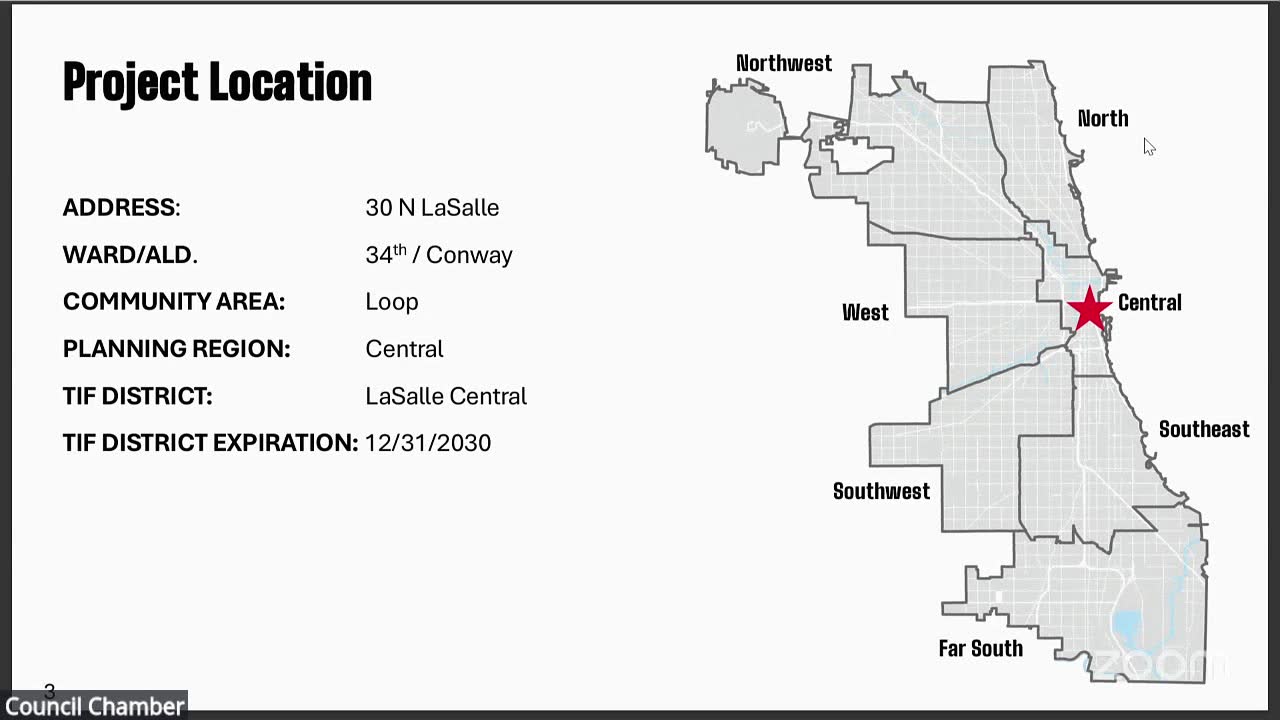
The City's money also comes with a clock. According to the Department of Housing's slide for the Finance Committee, the LaSalle Central TIF district expires at the end of 2030. The TIF money for this project comes from that district.
What it means for the Loop
For the Loop, the project would add 349 rental homes to a block of LaSalle Street that has been offices for half a century. The 105 affordable units would put income-restricted housing in the middle of the financial district.
The deal hasn't closed. According to our summary of the September ordinance, the Commissioner of Planning and Development can now sign the revised agreement. You can follow each step on its page: the revised redevelopment agreement, the fee waiver and the landmark designation.