

Bryn Mawr Avenue in Edgewater is now a Chicago Landmark district. Here's what changes
The Council designated West Bryn Mawr Avenue between Sheridan Road and Broadway on Sept. 23; exterior changes seen from the street now face landmark review.
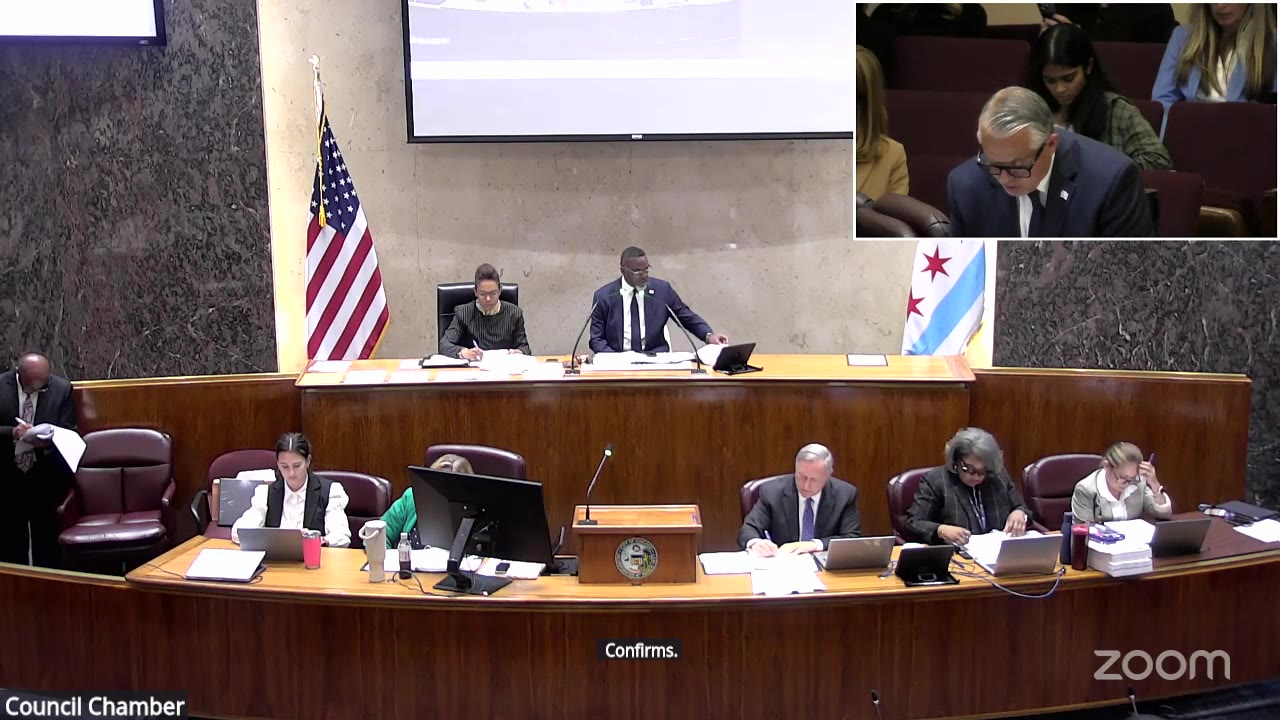
The 900 to 1100 blocks of West Bryn Mawr Avenue in Edgewater are now a Chicago Landmark district. The City Council passed the designation, O2026-0027059, on Sept. 23 by a vote of 50 to 0, in the report of the Committee on Zoning, Landmarks and Building Standards, without debate. From now on, changes to the outside of the district's buildings that can be seen from the street or sidewalk go through the City's landmark permit review.
The district is in the 48th Ward, represented by Ald. Leni Manaa-Hoppenworth.
What is in the district?
The Bryn Mawr Avenue District runs predominantly along Bryn Mawr between Sheridan Road and Broadway, with the CTA Red Line's Bryn Mawr station at its center. The Commission on Chicago Landmarks' designation report counts 15 contributing buildings, built during the district's period of significance, 1897 to 1929, and seven non-contributing ones, either built later or altered too much to convey the district's history. The rebuilt CTA station, which the report says the CTA completed in 2025, is among the non-contributing buildings.
The ordinance describes a remarkably intact group of mostly two- and three-story store-and-flats buildings, with three large apartment buildings, built between 1897 and 1928. Styles range across Classical Revival, Queen Anne, Romanesque Revival, Gothic Revival, Mediterranean Revival and Arts and Crafts, in brick, stone, terra cotta and metal. Architects include Benjamin H. Marshall and J.E.O. Pridmore, and the firms Koenigsberg & Weisfeld, Levy & Klein, and Perkins, Fellows & Hamilton. One religious building on the corridor serves a congregation with long ties to the street.
Why does the City consider it historic?
The ordinance traces the district to John Lewis Cochran, regarded as the founder of Edgewater, whose first subdivision laid out streets, utilities and houses for what was meant to be an exclusive railroad suburb, with Bryn Mawr Avenue and the Edgewater train station in its first residential development. Chicago annexed the area in 1889, part of an expansion of about 125 square miles. The Commission found the district meets four of the City's landmark criteria, numbers 1, 4, 5 and 6 in the Municipal Code, and recommended designation on July 9, 2026.
The designation report adds that the corridor has worked as a neighborhood shopping street for over 140 years, and that after several years of rising storefront vacancies, the reopened train station has brought pedestrians back and new businesses are on the rise.
What does landmark status change?
The ordinance identifies the protected features as all exterior building elevations, including rooflines, visible from public rights-of-way. Work on those features now needs review under the landmark permit sections of the Municipal Code before the City issues a permit. Interiors, and exterior walls not visible from the street, are not covered.
The contributing or non-contributing label guides how the Commission treats a building, and the report says it is provided so owners and the public can anticipate that treatment. Individual owners keep the right to petition the Commission and the City Council on whether their building is contributing or non-contributing. The ordinance contains no money: the City's summary of it lists no dollar amounts, and it creates no grant or tax program on its own.
How did the vote go?
The ordinance reached the Council on July 15 as a transmittal from the Commission, and the Zoning committee recommended it on Sept. 22. On Sept. 23, the committee's chair, Ald. Gilbert Villegas (36th Ward), read the landmark designations of the Shop Building at Altgeld Gardens in the 10th Ward and the Bryn Mawr Avenue District in the 48th Ward together and moved them by the same motion the Council had used earlier in the meeting. Hearing no objection, the chair declared them so ordered. No alderperson spoke on the designation, and Manaa-Hoppenworth did not address it on the floor. All 50 alderpersons are recorded voting yes; the Clerk also notes an unsuccessful motion to reconsider by Ald. Gregory Mitchell (7th Ward).
How each ward voted
50 yea · Sep 23, 2026 · Passed
 1Daniel La Spata: Yea
 2Brian Hopkins: Yea
 3Pat Dowell: Yea
 4Lamont J. Robinson: Yea
 5Desmon C. Yancy: Yea
 6William E. Hall: Yea
 7Gregory I. Mitchell: Yea
 8Michelle A. Harris: Yea
 9Anthony Beale: Yea
 10Peter Chico: Yea
 11Nicole T. Lee: Yea
 12Julia M. Ramirez: Yea
 13Marty Quinn: Yea
 14Jeylú B. Gutiérrez: Yea
 15Raymond A. Lopez: Yea
 16Stephanie D. Coleman: Yea
 17David H. Moore: Yea
 18Derrick G. Curtis: Yea
 19Matthew J. O'Shea: Yea
 20Jeanette B. Taylor: Yea
 21Ronnie L. Mosley: Yea
 22Michael D. Rodriguez: Yea
 23Silvana Tabares: Yea
 24Monique L. Scott: Yea
 25Byron Sigcho-López: Yea
 26Jessica L. Fuentes: Yea
 27Walter R. Burnett: Yea
 28Jason C. Ervin: Yea
 29Chris Taliaferro: Yea
 30Ruth Cruz: Yea
 31Felix Cardona Jr.: Yea
 32Scott Waguespack: Yea
 33Rossana Rodríguez Sánchez: Yea
 34William Conway: Yea
 35Anthony J. Quezada: Yea
 36Gilbert Villegas: Yea
 37Emma Mitts: Yea
 38Nicholas Sposato: Yea
 39Samantha Nugent: Yea
 40Andre Vasquez Jr.: Yea
 41Anthony V. Napolitano: Yea
 42Brendan Reilly: Yea
 43Timothy R. Knudsen: Yea
 44Bennett R. Lawson: Yea
 45James M. Gardiner: Yea
 46Angela Clay: Yea
 47Matthew J. Martin: Yea
 48Leni Manaa-Hoppenworth: Yea
 49Maria E. Hadden: Yea
 50Debra L. Silverstein: Yea
O2026-0027059: the roll call, the timeline and the documents
What it means on your block
If you own, rent or run a business in one of the district's buildings, the outside walls facing Bryn Mawr are now part of a landmark. Replacing windows, changing a storefront, altering a cornice or a roofline: anything visible from the street or sidewalk now goes to landmark review as part of the permit. Inside work does not. The report describes the district as still doing the job it was built for, shops at the sidewalk and apartments above, with newer buildings that have respected that scale, and it says the historic character of most buildings is recoverable through rehabilitation and restoration.
If you live nearby, the designation does not change your building unless it is one of the 15 contributing or seven non-contributing buildings in the district. Follow the ordinance, the Commission's recommendation and the building catalog on the ordinance's page. If you have questions about a specific building's status, the report says owners can petition the Commission and the Council. Manaa-Hoppenworth's 48th Ward office is the local contact.